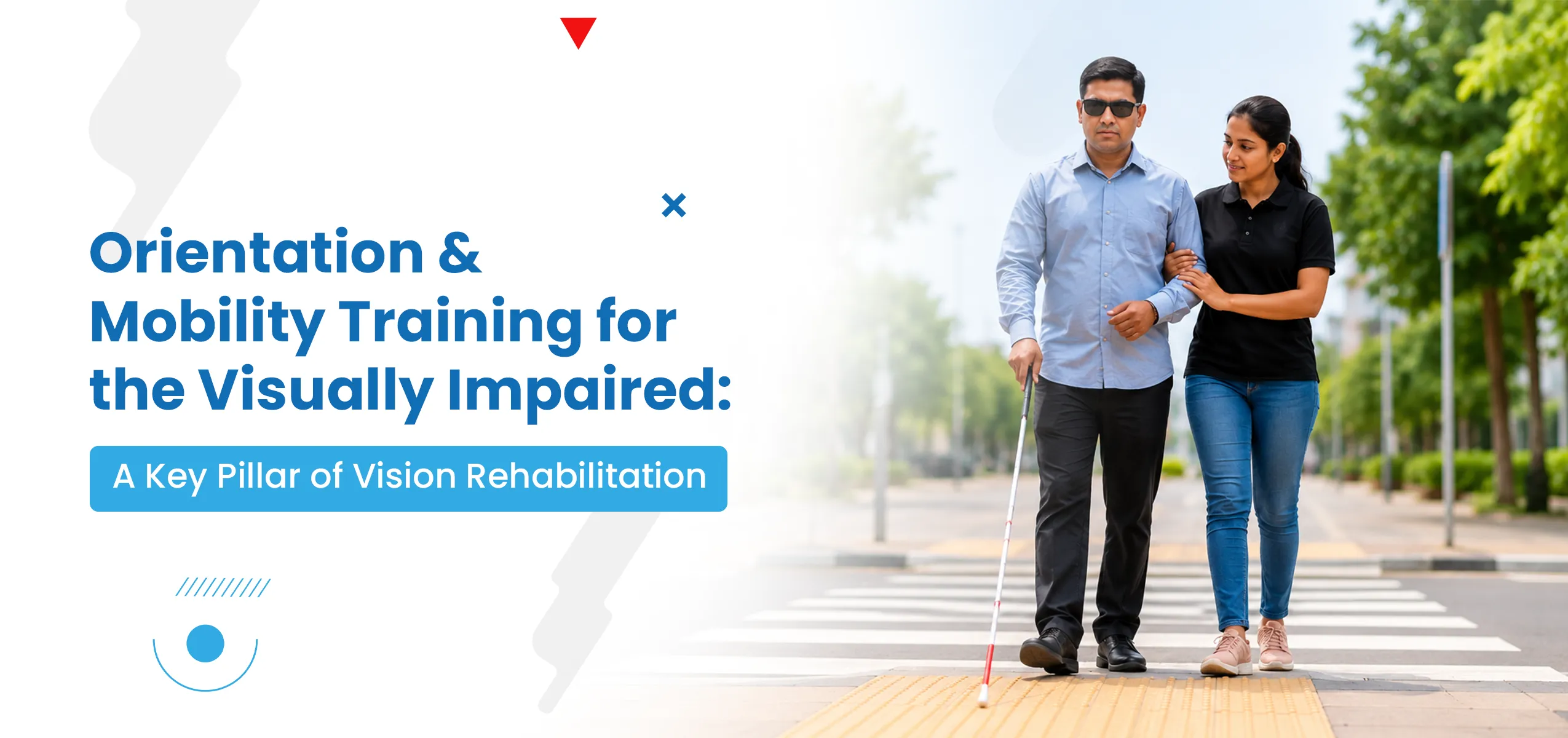
Introduction
Losing part or all of your sight can feel like the world is shrinking. Simple everyday tasks—walking along the road, crossing streets, navigating a shop—can become frightening. Yet, you don’t have to resign yourself to dependence. Through vision rehabilitation, a powerful component is orientation and mobility training (often called O&M).
In this article, you’ll learn:
- What orientation and mobility training means
- Why it’s so important for the visually impaired
- How the training works (techniques, environments, devices)
- Who’s eligible and when to start
- Challenges, limitations, and realistic expectations
- How Drishti Eye Care System can help you regain safe independence
- FAQs to clear common doubts
Let’s begin on the path toward moving confidently once again.
What Is Orientation & Mobility (O&M) Training?
Orientation means knowing where you are in relation to your surroundings—understanding your position, the layout, and where you want to go. Mobility refers to moving safely, efficiently, and confidently from one place to another. Together, O&M training helps visually impaired individuals navigate their world using nonvisual senses, remaining vision, technology, and strategy. Medical News Today+2ConnectCenter+2
In the field of vision rehabilitation, O&M is considered a core service to help restore independence. For many, it is as fundamental as assistive devices or daily living training. National Council on Aging+1
Why Orientation & Mobility Training Matters
When vision is limited, there are several real-life challenges:
- Bumping into furniture, walls, or obstacles
- Difficulty walking in unfamiliar places
- Fear when crossing roads or uneven pavements
- Getting lost or disoriented, even indoors
- Anxiety about moving outside or using public transport
Without training, many may restrict their movement, become isolated, decline in physical fitness, or lose confidence. O&M empowers you to:
- Regain confidence in familiar and new environments
- Move safely and reduce risk of falls or accidents
- Increase mobility and social participation
- Combine training with assistive devices for better results
Research shows O&M training in adults with low vision contributes to safer mobility, better orientation, and more active participation in community life. PMC+1
Who Can Benefit & When to Start
Virtually anyone with vision impairment where standard correction (glasses, surgery) is insufficient can benefit from O&M training. This includes:
- People with low vision or partial sight
- Those with field defects (tunnel vision, hemianopia)
- Individuals with retinal diseases, glaucoma, optic nerve damage
- Persons with neurological vision loss (stroke, brain injury)
- Older adults whose vision is declining
The best time to begin is as early as possible, once your vision stabilizes. Waiting too long often leads to reduced mobility confidence and loss of skills.
Structure & Techniques in O&M Training
Assessment & Planning
Before training begins, a specialist conducts an O&M evaluation:
- Assess visual function (fields, acuity, contrast)
- Understand the person’s daily routes, challenges, goals
- Evaluate mobility skills (walking, balance, stepping)
- Consider physical factors (strength, balance, hearing)
With this, a personalized plan is created, tailored to your needs, environment, and goals.
Basic Techniques & Skills
Some core skills taught include:
- Use of a white cane or symbol cane — learning proper grip, cane techniques, scanning, obstacle detection. mabvi.org+3Wikipedia+3Medical News Today+3
- Human guide techniques — following or giving direction when someone leads
- Trailing and edge following — using walls, edges, or railings as tactile guides
- Touch and tactile orientation — detecting curbs, steps, textures, changes in surface
- Auditory cues & environmental sounds — using traffic, ambient noise, echoes as landmarks ConnectCenter+1
- Route planning & mental mapping — creating internal maps of common routes
- Street crossings & traffic negotiation — learning safe crossing techniques, timing, listening
- Use of technology & navigation tools — smartphone GPS, auditory wayfinding, apps
Training Environment Progression
O&M training typically progresses from:
- Controlled, indoor environment — safe rooms, hallways, corridors
- Campus or neighborhood simulation — quiet streets, known routes
- Community environments — bus stops, shops, crowded areas, roads
- Unfamiliar or complex environments — markets, crosswalks, night navigation
Each stage builds confidence and competence before moving to the next.
Frequency & Duration
Training is usually one-on-one and tailored in timing. Many programs run for several weeks or months, with regular practice and reinforcement. PMC+1 O&M specialists (sometimes certified, e.g. COMS) deliver the sessions. ACVREP
Benefits, Challenges & Realistic Expectations
Benefits
- Safer mobility and fewer accidents
- Greater confidence outdoors and indoors
- Increased independence and social engagement
- Complementary to assistive device use
- Long-term physical activity and mental well-being
Challenges & Limitations
- Learning curve and initial fear
- Environmental unpredictability
- Physical limitations (balance, stamina, hearing)
- Fatigue and sensory overload
- Need for continuous practice and reinforcement
It’s important to understand that O&M training does not restore vision; rather, it teaches compensatory strategies to move safely and confidently.
When to Seek Help & How Drishti Eye Care System Supports You
If you or your loved one is increasingly avoiding walking, traveling, or daily journeys due to vision challenges, it’s time to consider O&M training. At Drishti Eye Care System, we offer:
- Comprehensive vision and mobility assessment
- Guided practice in real-world environments
- Integration with assistive devices
- Follow-up support, retraining, and adjustment
Book a consultation with our O&M specialist today and take the first step toward safer, more confident mobility.